

Deep Red Regolith / Ice Breaks Consortium
January 15th - April 15th, 2026
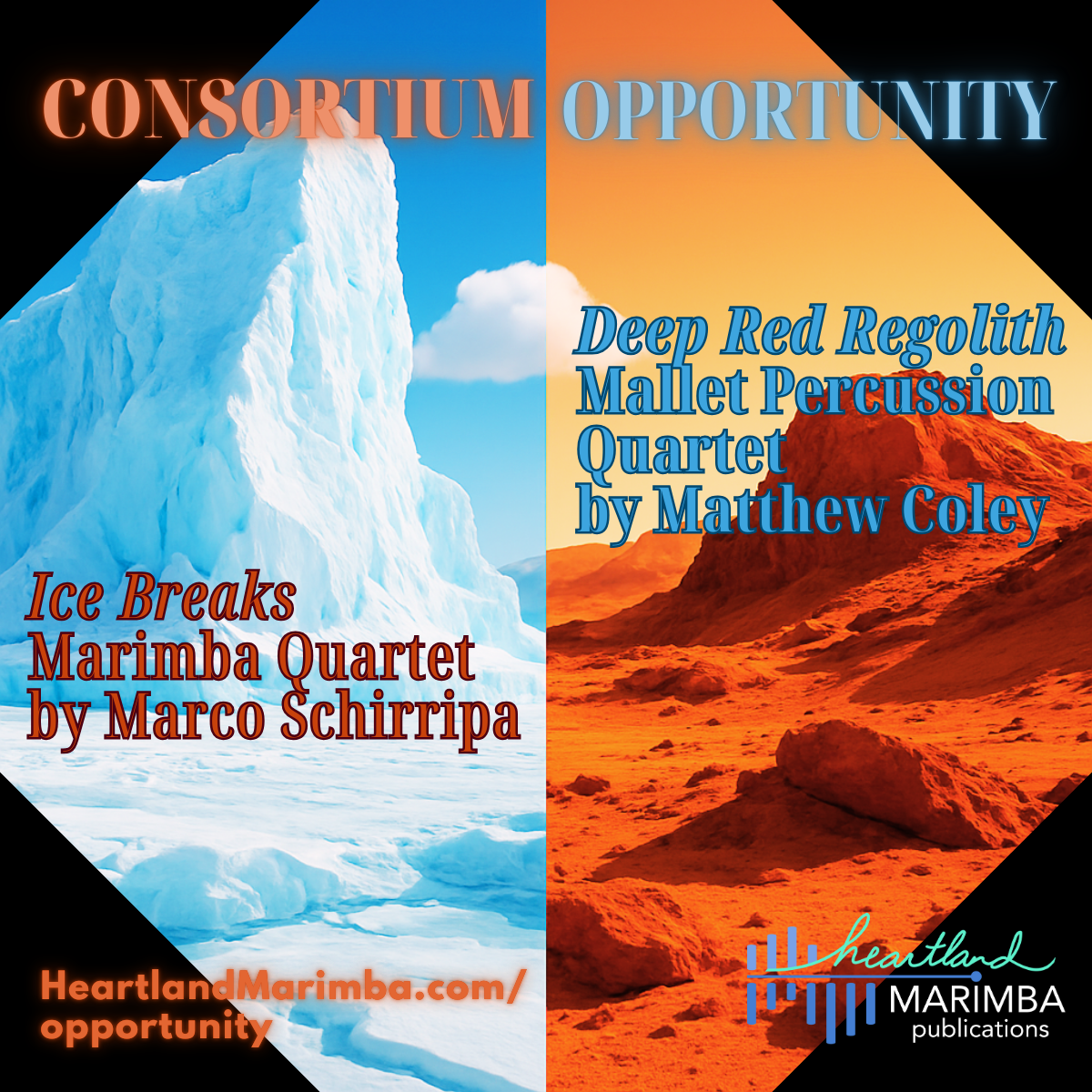
Join the Consortium for two original works for marimba ensemble by Heartland Marimba Artists Matthew Coley and Marco Schirripa.
Join the Consortium for two new fascinating works!
Deep Red Regolith
Mallet Percussion Quartet by Matthew Coley
Ice Breaks
Marimba Quartet by Marco Schirripa
Consortium Members receive the following:
- Printed and PDF Score and Parts
- Performance Exclusivity for Premieres May of 2026 to May of 2027
- Name of consortium member or organization listed in score and on Heartland Marimba Publications product page
- Virtual conversation with Matthew & Marco on the creation of the works
*Heartland Marimba Artists will serve as Lead Commissioners, presenting the World Premiere in April 2026 at the Gallagher-Bluedorn Performing Arts Center.
Consortium Details
– Open: January 15th - April 15th, 2026
– Work Delivered: May 1, 2026
Studio Consortium Member – $100 (Plus $5 online processing fee.)
Contribution made on behalf of a group of percussion instructor(s) and their students
Individual Consortium Member – $50 (Plus $5 online processing fee.)
Individual performer, educator, or supporter
There is no processing fee for mailed checks. Payment can be mailed to:
Heartland Marimba Festival
P.O. Box 2011
Waterloo, Iowa 50704
About the Works
Deep Red Regolith is a new keyboard percussion quartet work by Matthew Coley in three movements. Regolith, a loose blanket of dust, broken rock, and other related materials covering solid rock, is present on the surface of Earth, but it is ubiquitous on Mars. In this epoch, dust, sand, and rock cover the entire planet; the dust is extremely fine and combined with planet-wide dust storms it gives the orb its visible reddish hue. The regolith can be quite deep in places. Each movement celebrates the mystery and haunting beauty of our neighboring world, utilizing marimbas, vibraphones, and crotales, played with a variety of methods to transport you to the carmine realm. Movement 1 is called "Mesospheric Arrival" for a specific type of cloud found only on Mars, high in the atmosphere. Movement 2, "Oceanus Borealis," captures the primordial ocean that is believed to once have covered a third of the planet's surface. And, the final movement, entitled "Valles Marineris," explores the massive system of canyons on the Martian surface (the largest canyon in the solar system)!
Ice Breaks for Marimba Quartet by Marco Schirripa is inspired by a large ice mass crumbling apart, and the additional environmental damage that might ensue - specifically A23a, the world’s largest iceberg which has broken up. The piece itself starts very open and sprawling, like a vast expanse of ice, and eventually becomes groovier and forward moving (like the rapid breaking up of the ice). The rhythmic and harmonic material borrows from both modern classical idioms and popular genres like EDM and video game music. The “wispy” sprawling sections are more gestural, using non-tonal pitch collections to create atmosphere, while the more rhythmic sections include pounding bass, metal-style breakdowns, and fast technical passages in parallel intervals.
DRR/IB CONSORTIUM FLYER
.png)